

Engineered For Your Success

22.07.2026

Mechanical Separation as a Key Technology in the Beverage and Dairy Industries

Driving Innovation Through Application-Focused Process Development

Rising raw material prices, increasing cost pressure, and more stringent sustainability requirements are creating fundamental challenges for the beverage and dairy industries. At the same time, demand for high-quality, protein-rich products and functional ingredients continues to grow. In this environment, mechanical separation technology is becoming increasingly important. It enables process streams to be efficiently fractionated, by-products to be upgraded, and processes to be designed for greater robustness and profitability.


Technologies such as decanter centrifuges, disc stack separators, and belt presses have long been established tools in the industry. However, their full potential often only becomes apparent when existing process limitations are challenged and new process engineering approaches are explored. Modern testing and development facilities—such as the new Flottweg Process Center—provide the ideal environment for evaluating, validating, and scaling new applications for industrial implementation.


The principle is simple: companies willing to question established processes and evaluate new approaches can unlock the full benefits of mechanical separation technology, particularly in terms of flexibility, profitability, and product quality.

Dairy Processing: Unlocking New Potential in Established Processes

Mechanical Separation as a key technology in the beverage and dairy industry

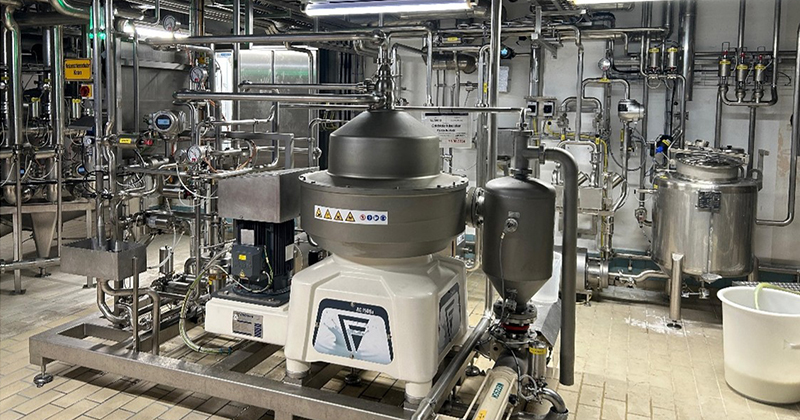
Centrifugal separation processes have been an integral part of dairy processing for more than 140 years. Yet current examples show that even well-established applications still offer untapped potential. Traditionally, membrane technologies or specialized nozzle separators are used to dewater fermented dairy products such as quark, yogurt, and skyr.


Decanter centrifuges offer an attractive alternative. One key advantage is their high degree of flexibility: different dewatering levels can be precisely adjusted, allowing production processes to adapt more easily to changing requirements. In addition, decanters can offer economic benefits through comparatively lower capital and service costs as well as high equipment availability. Given the continued growth in demand for protein-rich dairy products, this creates additional opportunities for plant operators.


Another practical example is the processing of mozzarella stretching water. This challenging by-product stream contains not only solids but also valuable fat components.


By using a three-phase disc stack separator with a specially designed bowl configuration, the individual phases can be separated efficiently. The use of customized high-performance materials ensures reliable operation even under demanding conditions. The recovered fats can then be returned to the production process, significantly improving raw material utilization.
Plant-Based Dairy Alternatives: Efficiency Throughout the Process Chain

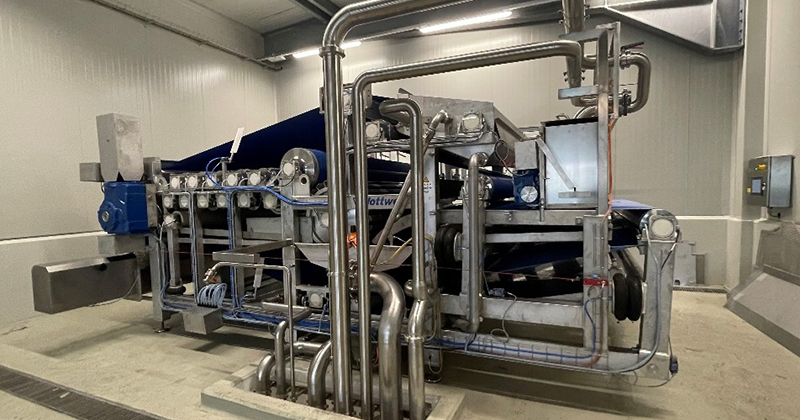
Typical Belt Press Installation in Food Processing

Flottweg has been supporting customers in the plant-based dairy alternatives market with separation solutions for decades. Decanter centrifuges are primarily used to separate plant fibers from raw materials such as soy, oats, and rice. In addition, opportunities for optimization also exist in upstream process steps.


Coconut milk production is one example. Conventional processes often rely on screw presses for extraction. However, higher yields can be achieved through an optimized milling process combined with specially designed belt presses.


In practice, yield increases of approximately 10–15% are possible. Against the backdrop of rising raw material costs and growing demand for plant-based products, this represents a significant economic advantage.

By-Products in the Brewing Industry: Turning Waste Into Value

Brewer's grains account for approximately 80–85% of all by-products generated during beer production, making them the largest by-product stream in brewing. Traditionally, they have been used primarily as animal feed. However, this approach depends heavily on regional conditions and is increasingly reaching logistical and economic limits.


At the same time, the challenges are growing. High moisture content, rising transportation costs, and increasing cost pressure are driving the need for alternative utilization concepts.


Modern decanter centrifuges enable efficient dewatering of brewer's grains and can achieve separation degrees of up to 98%. Valuable components such as proteins and dietary fibers remain concentrated in the solids and can serve as raw materials for protein concentrates, functional ingredients, and food applications. As a result, a traditional by-product becomes a valuable raw material—and disposal turns into value creation.


The liquid phase also offers savings potential. Depending on its quality, the separated process water can be reused within the brewing process, for example as process water or rinse water. This helps reduce fresh water consumption and lower wastewater volumes.

Fruit and Vegetable Juices: Targeted Separation for Demanding Products

Centrifugal separation technology is also widely used in the processing of fruit and vegetable juices. Nevertheless, significant optimization opportunities still exist, particularly in terms of yield and product quality.


Decanter centrifuges can, for example:
 

  • Further process retentates from ultrafiltration processes
  • Improve profitability when processing difficult-to-filter raw materials
  • Reduce waste streams


Another approach is known as classification. In this process-engineering-intensive application, particles are selectively separated based on differences in density and particle size. In practice, this can be used in tropical fruit juice production to remove unwanted particles ("black specs") while retaining the desired pulp in the final product. The flexible adjustment options of modern decanters make it possible to perform such separation tasks with precision.

The Importance of Process Engineering Design

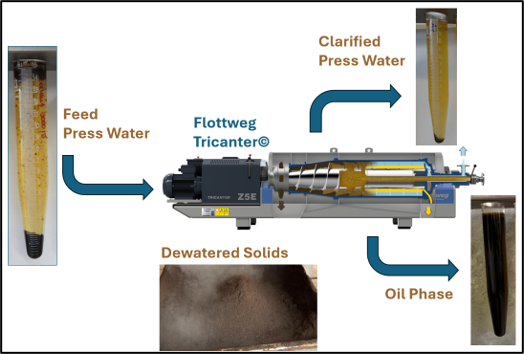
Three-Phase Separation of Coffee Press Water

Selecting the right machine typically begins with a detailed analysis of the product streams. Laboratory investigations and pilot trials provide the foundation for evaluating separation behavior, yield, and product quality.


To support this process, Flottweg offers comprehensive testing capabilities both within its existing process engineering facilities and at the new Process Center, which can replicate complete process chains under realistic conditions—from initial laboratory analyses through to pilot-scale trials.


Many of the applications described above, such as the processing of complex by-product streams or yield optimization projects, can be evaluated in advance under practical operating conditions. The objective is to identify opportunities together with the customer and define the next steps on a sound technical basis.


A recent example demonstrates the value of this approach:

During instant coffee production, the presence of coffee oil was identified in the press water stream. By utilizing a three-phase Tricanter®, the stream was successfully fractionated and its individual components recovered for further use. This resulted in a significant upgrading of the by-product stream.

Conclusion: Identifying and Leveraging Hidden Potential

Examples from dairy processing, beverage production, and plant-based manufacturing demonstrate that mechanical separation technology is far more than a conventional process step. It provides tangible opportunities to:


  • Increase process flexibility
  • Improve yields
  • Utilize by-product streams economically
  • Use resources more efficiently


The key lies in combining technological expertise with application-focused process development. Companies that challenge existing processes and explore new approaches can unlock additional potential and position their production operations for long-term competitiveness.

Author

Andreas Metzenauer is the Sales Director for Beverage and Dairy Industries at Flottweg. With many years of experience in mechanical separation technology, he supports customers worldwide in developing and optimizing process solutions for the beverage and dairy sectors, with a focus on efficiency, product quality, and sustainable resource utilization.