



- Extreme corrosion resistance (PREN up to 42) for exceptional durability
- Efficient sludge and brine management
- Energy-efficient systems with global service support
Sea water desalination converts saline seawater into fresh water by separating it into potable water and concentrated brine. The technology is essential for securing drinking water, agricultural irrigation, and industrial water supplies, particularly in regions with limited freshwater resources. Efficient sludge dewatering and environmentally responsible brine handling are key factors for sustainable and compliant desalination plant operation.
Addressing Global Water Scarcity Challenges
Ensuring Essential Water Resources for Today and Tomorrow - Powered by Flottweg Decanters
Although our planet is largely covered by water, 97% of it is saltwater, leaving only a small amount of freshwater available. Water shortages are increasingly challenging in several countries around the world. Due to reduced rainfall and growing populations, there is an increased need for high-quality water - whether for drinking water supply, agricultural irrigation, food production, or industrial applications. In response, governments, municipalities and industries worldwide are turning to desalination as a practical and sustainable solution for securing the water supply, making a significant contribution to meeting global water demand.
Seawater desalination is particularly important in regions with limited freshwater resources, such as the Middle East and desert areas of North Africa. In these regions, the energy‑intensive production of drinking and process water is often powered by fossil fuels like heavy oil or natural gas. In the oil‑rich Gulf states, seawater desalination is the main source of drinking water. Furthermore, desert regions like North Africa and the Middle East offer ideal conditions for the production of green hydrogen due to high solar radiation. However, the required amount of freshwater can only be obtained through seawater desalination.
Flottweg offers advanced separation technologies that are essential for seawater desalination. Our decanter centrifuges withstand the harsh conditions in desalination plants and ensure reliable sludge dewatering as well as efficient and environmentally sound brine disposal. With decades of experience and a consistent focus on quality and innovation, Flottweg optimizes plant performance and sustainably reduces operating costs.
In addition, Flottweg develops customized solutions that are precisely tailored to the requirements of individual desalination projects. Complemented by a global service network, we ensure maximum plant availability, long-term operational reliability, and a significant reduction in the environmental impact of modern desalination plants through expert support and professional maintenance.
Decanters for Sea Water Desalination
Desalination Process
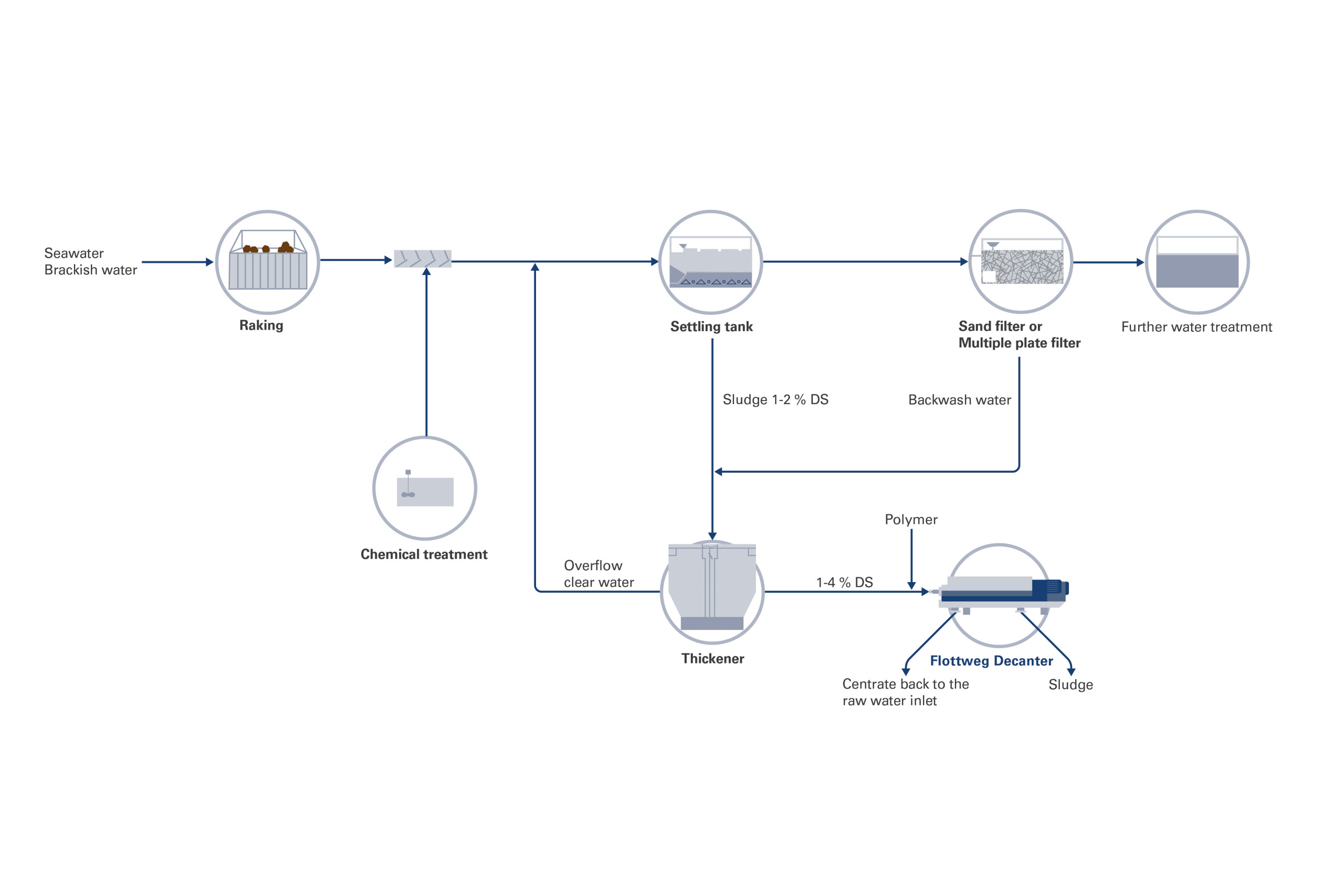
The desalination process involves separating salt water into two streams: one containing treated or fresh water with a low salt concentration, and the other with a significantly higher salt concentration, known as brine concentrate or simply brine. The process starts with the intake of seawater, brackish water, or raw water, which is then pre-treated to remove coarse suspended solids and minimise sludge production. This crucial step minimises contamination and establishes optimal conditions for the subsequent stages of the process.
Following its pre-treatment, the water then passes through an additional filter system before being fed into the second stage of the drinking water treatment process. During this main phase, either reverse osmosis (RO) or thermal treatment takes place, during which the desalination of the water occurs.
Sediments from the pre-treatment together with filter back-wash water are sent into sedimentation basins, where the additional treatment steps follow. Sludge containing 0.5-2% total solids (TS) is sent to thickeners or flotation units, with the overflow water recycled back to the raw water intake of the plant.
Thickened sludge (1-4% TS after polymer addition) proceeds to a decanter centrifuge for dewatering. The resulting sludge is handled separately, while the centrate returns to the raw water intake.
Finally, the desalinated water is subjected to post-treatment to meet freshwater quality standards.
Corrosion-Resistant Materials and the Importance of PREN

Corrosion Resistance
Flottweg decanters are designed to withstand the aggressive conditions of seawater desalination. All wetted components are engineered for the maximum corrosion resistance, ensuring long-term durability and minimizing unplanned downtimes due to material degradation.

High PREN Materials
We use stainless steels with a pitting resistance equivalent number (PREN) of up to 42—well above standard industry requirements. This ensures exceptional resistance to localized pitting corrosion in chloride-rich environments, which is critical for the reliability and longevity of desalination equipment.
In the desalination process, materials are required to withstand the high salt concentrations present, especially in terms of all wetted components. Super-duplex steels typically meet these stringent demands, although a combination of duplex and super-duplex materials can be used for brackish water applications. A key factor when selecting materials is the pitting resistance equivalent number (PREN), which predicts the resistance of stainless steels to localized pitting corrosion in chloride-rich environments. The higher the PREN value, the better the corrosion resistance. Flottweg places a strong emphasis on ensuring the quality and durability of its desalination plants. Our commitment to excellence is demonstrated by offering materials with a PREN of up to 42, which exceeds the typical industry requirements and ensures superior resistance to localized pitting corrosion in chloride-rich environments.
Besides corrosion resistance, mechanical strength, ductility and weldability are vital considerations, as materials have to endure high pressures and temperature fluctuations. At Flottweg, we use special corrosion-resistant materials and apply proprietary coatings and colors designed to provide enhanced protection against corrosion. These advanced protective measures significantly extend the lifespan of the plant components and reduce the maintenance needs, while also supporting eco-friendly practices aligned with global sustainability goals.
Environmental factors are increasingly important, with a trend toward sustainable materials that reduce the carbon footprint of facilities. Our focus on premium materials and innovative corrosion protection reflects our dedication to delivering desalination plants that perform reliably and sustainably over the long term. By integrating these high-quality materials and advanced protective technologies, Flottweg ensures that our desalination plants maintain an optimal performance and durability, supporting global efforts to provide safe, sustainable freshwater solutions amid increasing water scarcity challenges.
Environmental and Socioeconomic Factors
Sea water desalination is essential for securing a reliable and drought-resistant water supply for communities and industries worldwide. While this approach offers several benefits, it also poses environmental challenges, particularly regarding energy consumption, chemical use, and brine discharge. Flottweg addresses these issues with advanced separation technologies that support sustainable and efficient plant operations. Our decanter centrifuges are designed for continuous, energy-efficient performance, enabling effective sludge dewatering and brine management. These systems reduce the environmental footprint of desalination facilities and improve compliance with environmental regulations. Additionally, the treatment of backwash and cleaning of effluents further protects marine ecosystems, ensuring that desalination remains an eco-aware solution to global water scarcity.
Besides its environmental advantages, sea water desalination provides significant socioeconomic benefits by delivering stable water supplies for drinking, agriculture, and industrial purposes. This supports economic growth, job creation, and improved public health. Flottweg’s reliable and durable technologies empower desalination plants to operate efficiently and sustainably, contributing to long-term development goals in water-stressed regions.
Why Choose Flottweg Decanters for Sea Water Desalination?
Optimized Sludge & Brine Management
Our decanter centrifuges provide highly efficient separation performance, enabling effective sludge dewatering and brine handling. This improves overall plant efficiency, reduces disposal costs, and supports compliance with environmental regulations.

Tailored Solutions with Global Support
Flottweg delivers customized solutions adapted to the specific needs of each desalination project. Our global service network ensures expert support, fast response times, and long-term operational reliability—maximizing uptimes and customer satisfaction.

Environmental Protection Measures
Protection of marine ecosystems is ensured by thorough treatment of backwash and cleaning effluents, as well as through the targeted reduction of chemical use. At the same time, waste management is optimized to ensure safe disposal and—where possible—sustainable recycling of waste.
Sustainable Water Supply
A stable and sustainable water supply is crucial for economic development, public health, and the resilience of water-scarce regions. Desalination plants convert seawater into drinking water, relieving pressure on traditional freshwater sources and supporting sustainable water management worldwide.
Get advice from our experts now