


- High dry matter values - up to 35% dry matter for minimal disposal costs
- 20% energy savings thanks to Recuvane® technology during continuous operation
- Automatic adjustment to variable feed and operating conditions during operation
HTS = Highest dry solids content
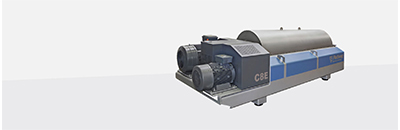
The centrifuge for dewatering sewage sludgeTransporting and disposing of sewage sludge accounts for a large portion of a sewage treatment plant’s operating costs. The lower the sludge volume, the lower the costs for transportation and disposal. Therefore, efficient sludge dewatering is the key to cost-effective plant operation.
Our Flottweg HTS Decanter achieves the highest possible dry solids content in dewatered sludge, continuously saving on transport and disposal costs. They enable the efficient and reliable treatment of a wide variety of municipal and industrial sewage sludges. By reducing sludge volume, they contribute to sustainable and resource-efficient operation.
Over 50 years of experience in sewage sludge dewatering and the continuous advancement of our separation technology form the foundation of the Flottweg HTS Decanter. Combined with references of successful projects from all over the world, this experience makes Flottweg one of the leading suppliers of mechanical separation technology.
Higher dewatering capacity through precise solids transport
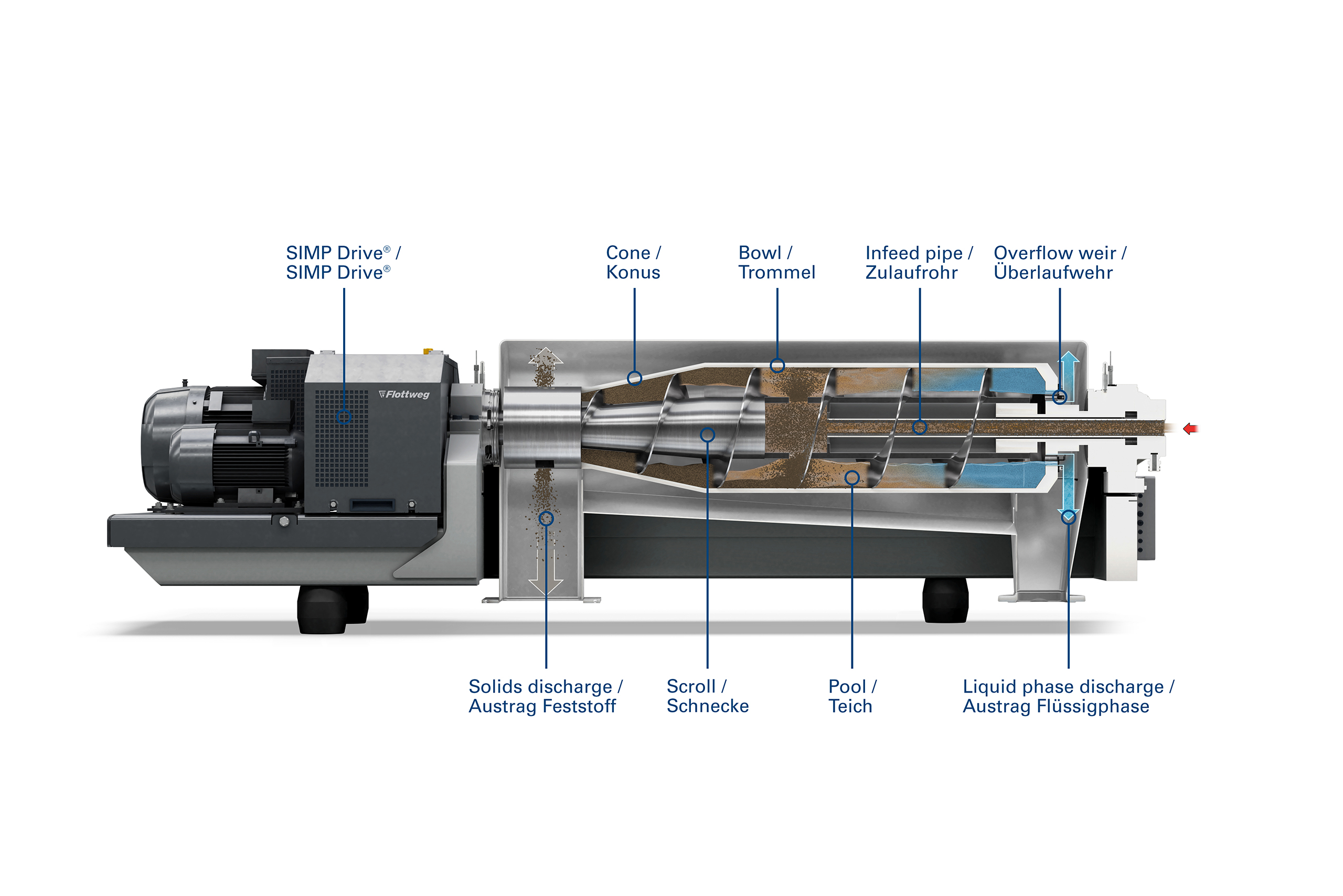
The decanter scroll conveys the solids deposited against the bowl wall by centrifugal force toward the conical end of the bowl at an optimal differential speed. This determines the residence time of the solids and influences the total dry solids. Various scroll designs allow for flexible adaptation to different products and processes.
Rapid process adaptation for consistently high performance
The overflow weir from Flottweg allows for precise adjustment of the pond depth in the decanter centrifuge. This enables the system to be flexibly adapted to process changes and significantly improves separation performance—all without disassembly.
Optimal separation performance thanks to variable differential speed
The differential speed between the decanter bowl and the screw conveyor determines the retention time and compaction of the solids, and thus the total dry solids. It is variably adjustable to ensure optimal separation results for varying product characteristics.
The following machines are available in the HTS version:

Performance Boost
- Low operating costs thanks to higher dewatering efficiency and reduced disposal costs
- Increased torque and open grid structure for improved performance and energy efficiency
- Reduced energy consumption and ecological footprint thanks to Performance Boost and Super-Deep Pond

Flex Concept
- Modular design enables customization and a wide range of options
- Additional taper angle enhances versatility and operational reliability
- Upgradeability and flexibility thanks to modular design and a wide range of options

Human-Centered Design
- Improved housing seal protects against environmental influences and reduces downtime
- Foldable belt guard allows for easy access for maintenance and repair
- Low-noise design improves working conditions and promotes ergonomic operation

The FW400 HTS offers state-of-the-art separation technology to significantly reduce sludge volume while efficiently and economically processing a wide variety of sludge types. It handles both municipal and industrial sewage sludge, which can have different properties and solids content depending on their origin.
With innovative features, high flexibility, and a user-friendly design, the FW400 HTS sets new standards in sewage sludge dewatering. As the newest member of the decanter product range, it offers forward-looking solutions for a wide range of requirements and helps sewage treatment plants make their processes more sustainable, efficient, and cost-effective.
How the Flottweg HTS Decanter functions
The digested sludge is pumped from the digestion tower into the sludge centrifuge, where dewatering is achieved by means of centrifugal force. During this process, the dry solids content of the sludge is increased from approximately 2–6% to 25–35%, significantly reducing the sludge volume. The Flottweg HTS Decanter is specifically designed to meet the demanding requirements of sewage sludge dewatering. It is suitable both for the dewatering of digested sludge and the direct dewatering of excess sludge.
Thanks to its robust design and optimized separation performance, the HTS Decanter enables reliable and cost-effective sludge treatment while improving overall process efficiency and simplifying sludge handling.
You can find more information about how our decanters work here.
Typical fields of application for the HTS Decanter


Frequently Asked Questions – FAQ
Depending on the sludge type and process conditions, the HTS decanter can achieve dry matter contents of 35% TS and higher.
The actual value that can be achieved depends in particular on the concentration, polymer dosing, and process control, and is therefore application-specific.
For a specific design, sludge characterization or a test using representative sludge should be conducted.
The HTS decanter continuously separates solids from liquids using centrifugal force and can concentrate sludge with a feed dry matter (TS) content of approximately 2 to 6% to approximately 25 to 35% TS in the dewatered sludge.
The sludge to be thickened or digested is continuously pumped into the decanter centrifuge. In the rotating drum-scroll system, the solids settle against the bowl wall due to centrifugal force. The scroll conveys the separated solids to the solids discharge, while the clarified centrate drains off.
Increasing the solids content also reduces the volume of sludge that needs to be transported and disposed of.
The HTS decanter is particularly suitable for dewatering digested sludge and excess sludge. The following parameters, among others, are relevant for a robust design:
- Inlet concentration
- Throughput
- Temperature
- Sand content
- Fibrous materials
- Suitability of the flocculant
The HTS decanter is designed for dewatering municipal and industrial sewage sludge. Typical applications include:
- Digested sludge from municipal sewage treatment plants
- Excess sludge from biological wastewater treatment
- Mixed sludge consisting of primary and excess sludge
- Industrial sludges with comparable separation properties
- Water treatment plant sludge, provided that the solids properties and conditioning are suitable for this purpose
In cases of highly variable sludge properties, a high abrasive content, fibrous materials, or special requirements for centrate and discharge quality, suitability should be confirmed through an application test.
The separation performance can be adjusted to accommodate varying sludge properties by adjusting the pond depth, the differential speed, the bowl speed, the flow rate, as well as the polymer dosing and conditioning.
- Pond depth: This is adjusted via the overflow weir or adjustable weir plates and influences the clarifying zone, the drying zone, and the quality of the centrate effluent.
- Differential speed: The speed difference between the bowl and the scroll controls the solids conveyance rate, solids retention time, and thus the dry matter content in the discharge.
- Bowl speed and flow rate: These are adjusted according to sludge type, solids content, and the required separation performance.
- Polymer dosing and conditioning: These are tailored to the sludge type, dry matter content, and desired dewatering.
An important difference lies in the adjustment process: The pond depth is set while the machine is at a standstill. The differential speed can be adjusted during operation to respond to changing process conditions.
The pond depth determines the liquid level in the bowl and thus the ratio of the clarifying zone to the drying zone.
A deeper pond extends the liquid’s retention time and tends to improve clarification performance. A shallower pond, on the other hand, increases the drying zone and can support higher dry matter content in the solids discharge.
The optimal setting for the pond depth is therefore always a compromise between:
- Centrate quality
- Solid discharge quality
- Throughput
- Energy consumption
The weir plates are adjusted while the system is at a standstill.
The achievable dry matter content is influenced by, among other factors, sludge type, influent concentration, process control, differential speed, as well as polymer dosing and conditioning.
The pond depth is also relevant: A shallower pond increases the drying zone and can thereby support higher dry matter contents in the solids discharge.
During design, throughput, temperature, sand content, and fiber content must also be taken into account.
A single operating parameter is therefore insufficient to predict the achievable dry matter content. For a reliable assessment, the specific sludge properties and operating conditions should be considered.
The HTS decanter uses Endrive gear oil and Sympact roller bearing grease.
Endrive Gear Oil:
- for the planetary gear drive
- Objective: long service life, wear protection, and energy-efficient power transmission
Sympact Roller Bearing Grease:
- for the bearings
- Objective: reliable lubricating film, reduced friction, and longer bearing life
For maintenance intervals, oil change quantities, permissible temperatures, and substitute lubricants, refer to the information in the respective instructions for use as well as the project-specific maintenance specifications.
The Recuvane® system typically reduces drive power by 10 to 20%. The actual savings depend, among other factors, on the pond depth, throughput, and sludge suitability.
The system returns to the main drive a portion of the rotational energy that is normally lost during the unpressurized discharge of the centrate.
The payback period depends on operating hours, energy prices, machine size, and the specific Recuvane® application; therefore, it can only be determined on a project-by-project basis. As a general guideline, a few months to two years is often cited. However, the actual payback period should always be determined based on individual operating conditions.
More Features of the HTS Decanter
Pond Depth
The pond depth affects the retention time of the liquid and thus the length of the clarification and drying zones. By adjusting the weir plates while the system is at a standstill, this can be specifically adjusted to optimize separation performance.

Lubrication
To ensure the service life of decanter centrifuges, Flottweg offers specially formulated lubricants. The Endrive gear oil ensures long-lasting drive performance with excellent wear protection and helps save energy. The Sympact roller bearing grease protects friction points and increases the service life of the bearings.

Recuvane®
The Recuvane® system lowers the operating costs of a decanter centrifuge by reducing energy consumption by 10 to 20%. It reclaims the rotational energy lost during the pressureless discharge of the liquid and assists the main drive. The mechanically robust system allows for the adjustment of multiple pond depths and typically pays for itself within a few months to two years.
Get advice from our experts now