


2026-01-16
Technology meets environmental awareness: Schielein optimizes sand & gravel washing with Flottweg’s decanter
Gravel and sand – unassuming materials of great importance: Whether in horticulture, road and civil engineering or as a component of concrete – aggregates such as gravel and sand are indispensable for the construction industry. Schielein Kies + Beton specializes in precisely these raw materials and supplies them in a wide range of qualities and for diverse applications. Sustainability and resource conservation are playing an increasingly important role in the company's business activities while regulatory requirements have placed new demands on its existing processes. To meet these demands, Schielein has implemented a closed water circuit – supported by the modern technology of Flottweg's decanter, which enables efficient and environmentally friendly water treatment.
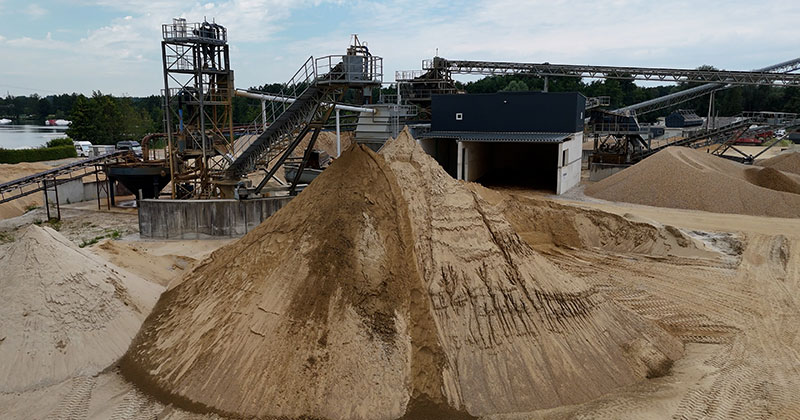
Actively shaping renaturation
Schielein Kies + Beton is currently managed by its third and fourth generations. Managing director Ludwig Schielein runs the company together with his two children, Julia Hecke-Schielein and Ludwig Schielein. Renaturation, species conservation and sustainability are very close to the company's heart: on the one hand, Schielein extracts sand and gravel as an important raw material for the construction industry; on the other hand, it actively transforms former raw material extraction sites into biodiverse natural areas. "Nature conservation requirements have top priority in renaturation. Our primary concern is to give more back to nature than we take from it," explains Julia Hecke-Schielein. “We see it as our task to create a symbiosis of sand and gravel mining, biodiversity and local recreation, and thus create added value for the entire region.”
How it works: sand and gravel extraction at Schielein
After the raw gravel has been extracted from the pits and open-cast mines, it is processed in the gravel works. This is an important step so that the sand and gravel can then be used for their corresponding purpose. The material is first washed, screened and sorted. In particular, the washing process of the raw material produces a lot of wash water, which must then be suitably processed by the company. For many years, Schielein used settling basins for this purpose. "We used to have an open water circuit," explains Robert Niedermeier, operations manager at Schielein Kies + Beton. "This means that the wash water was directed into a settling pond and stored there. This pond was dredged once or twice a year, and the sludge was then transferred to other ponds." Dredging the settling basins was a particularly labor-intensive and time-consuming process. In addition, the company's water consumption for the washing process was very high.
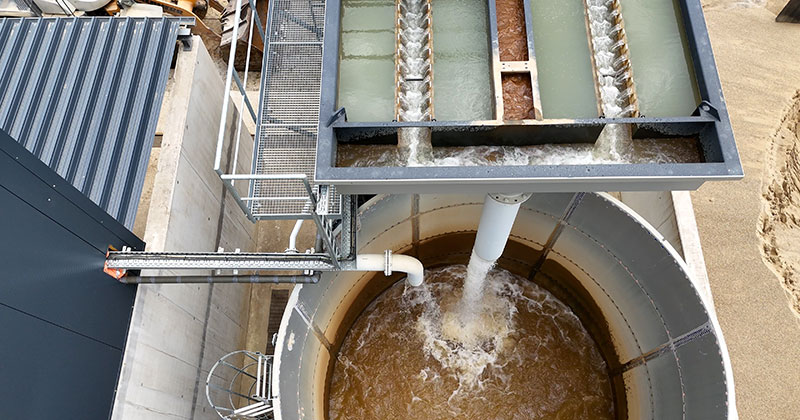
From an open to a closed water circuit with Flottweg's decanter
Due to a regulatory requirement, Schielein finally decided to convert its open water circuit, subsequently opting for a high-performance centrifuge from Flottweg for the new, closed water circuit. Since then, the resulting wash water has been processed with a decanter. The process water is purified, and the solid matter is separated so that it can then be disposed of separately.
While searching for a technical solution for a closed water circuit, Schielein explored several different options. The decanter was ultimately selected because of the low personnel requirements and the ease of operation. The implementation of the centrifuge in the existing process also went smoothly: "The introduction of the decanter was planned well in advance in conjunction with Flottweg and finally implemented. During the installation, we received continuous support from Flottweg technicians," says plant manager Niedermeier in describing the process changeover.
In particular, a noticeable reduction in water consumption is evident. This allows the recovered process water to be reused. In addition, hardly any refill water is required for the overall process. The decanter also requires much less space than the settling basin. In summary, the centrifuge is proving to be the right solution for the process: "We have little maintenance, minimal wear and tear, lower energy consumption and the system simply works without problems," emphasizes managing director Ludwig Schielein.
Robustness through wear protection
A key element of Flottweg decanter centrifuges is their durability – even with abrasive materials. The scroll helixes are armored with silicon carbide, one of the toughest materials on the market. In addition, silicon carbide bushings ensure minimal wear at critical points on the machine. As a result, the centrifuge can also process the sand and gravel wash water reliably and continuously.
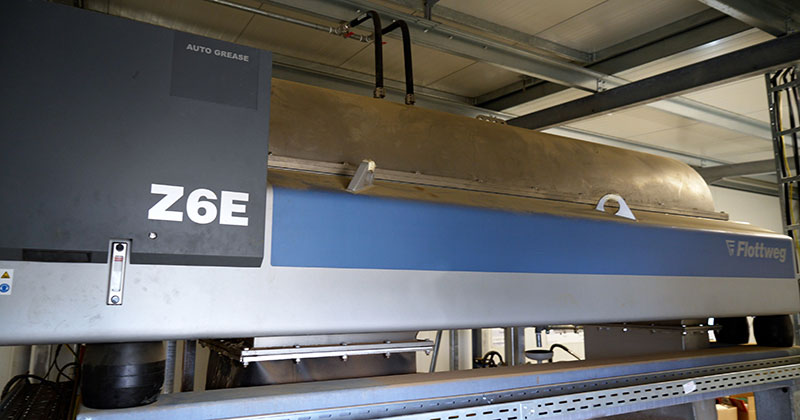
Important for decision-making: the test phase
By converting to a closed water circuit, Schielein needed to make some adjustments to the process, while construction measures were also necessary. For this reason, it was important for managing director Ludwig Schielein to test the feasibility in a trial period. "Ultimately, we were able to answer the following questions: What can the centrifuge do? What sludge does it produce? How can we handle this sludge at the end? In this regard, the test phase was invaluable for us to define the basic parameters. In the end, we had great confidence in building the system as planned." The test machine allowed Schielein to simulate how a closed water circuit might behave.
The results of the test phase were then analyzed and sampled accordingly by Schielein. Both the process water and the sludge were examined to ensure that the desired parameters are met. The quality of the recovered water was particularly important to ensure that it can be reused in the process. At the same time, certain sludge sampling parameters had to be achieved. The test phase lasted around three days, during which time Flottweg test technicians provided on-site support.
Flottweg's expertise impresses
Looking back, Schielein is satisfied with the decision to switch to a closed water circuit as well as with its implementation alongside Flottweg as a solution provider. "We noticed that whatever Flottweg sets out to do, that is exactly what it delivers. It is that expertise that we particularly value," explains managing director Ludwig Schielein. This trust in Flottweg's technical expertise and the excellent partnership throughout the entire project phase were decisive factors in the successful implementation. In particular, it was the test phase prior to the final implementation that made it possible to realistically assess the basic parameters and optimally adapt the system to the operational requirements.
With the new system, Schielein successfully combines environmental responsibility and economic efficiency, serving as an effective example of how modern technology and environmental awareness can go hand in hand. The changeover shows that sustainable solutions are not only possible, but also practical and forward-looking.