


2025-12-18
Centrifuge Technology in the SX Process Provides 60% Solvent Loss Reduction
The Solvent Extraction process (SX-Process) is a mining operation where metals such as copper, platinum, gold, cobalt, nickel, zinc, uranium, etc. are recovered by using chemical agents. After the SX-process is the Electrowinning process (also called electroextraction) is the electro-deposition of metals that have been put in solution via a process commonly referred to as leaching. Electro-refining uses a similar process to remove impurities from a metal.
Most commercial SX plants suffer from the formation of crud—a solid-stabilized emulsion that commonly accumulates at the aqueous/organic interface in the settlers of solvent-extraction stages. It is caused by a variety of substances entering the SX circuit, ranging from wind-blown dust, entrained solids from leaching, impurities in plant solutions, and even insects attracted by the lights in the solvent-extraction plant.
While a thin layer of crud at the aqueous/organic interface can aid coalescence of fine droplets, excess crud can interfere with phase separation and severely reduce the efficiency of the settlers. If allowed to build up in the settlers, crud can start moving to the next mixing stage. This can rapidly cause a “crud run” resulting in severely increased entrainment. This causes contamination of electrolytes with the leach solution and organic phase.
The transfer of organic to the electrowinning can cause “cathode burn.” The entrainment of electrolyte into the extraction section of the solvent extraction can result in loss of copper to the raffinate (in this case when refining copper). Entrainment of organic in the raffinate will result in increased organic losses. While removal of crud from solvent-extraction plants does not usually pose a major problem, crud typically has an organic content of more than 50%. Losses of organic with the crud can cost plants hundreds of thousands of dollars per annum.

Solving Crud in the SX Process with Technology
Centrifuges help to avoid losses of the organic solution while maintaining the efficiency of the SL loading and the SX stripping process. The process helps to maintain the control of the pH value and extend cathode life in electrowinning to avoid plant downtime due to settler cleaning.
A variable impeller allows for precise on-the-fly adjustment. This optimizes the purity of recovered organic solution even with fluctuating process conditions and provides a maximum solvent recovery which reduces solvent losses by up to 60%.
This process helps refineries that produce 20t/a of copper, or more. Centrifuges are also used for this purpose in small, medium, and large copper mines worldwide and are specifically used in mines that use the solvent extraction (SX) process. Plant manufacturers, design offices, and EPC contractors who are active in mining can also benefit from the use of centrifuges for this critical process.
Case Study 1 – Bwana Mkubwa, Zambia
For Bwana Mkubwa, a copper producer inNdola, on the Zambian Copperbelt, the inability to process crud efficiently resulted in several SX plants struggling with a build-up of crud in the SX settlers. This caused severe problems in the SX process and reduced the availability of the process by as much as 10%.
Zambia and the Democratic Republic Congo account for 1.2 Mt/a of SX/EW of copper production, of which at least 80% is produced in plants using 3-phase centrifuges for crud treatment. At a savings of USD 12/t Cu, that amounts to an annual savings of $12 million USD on just this one application in these two countries.
The Challenge
Twenty years ago, most copper refineries worldwide were struggling with significant financial losses caused by the formation of crud in their solvent extraction (SX) plants. Removal of the crud from the process, while essential, resulted in organic extractant and diluent losses that amounted to hundreds of thousands of dollars annually. Standard recovery techniques using filter presses were laborious and ineffective. Even after filtration, the crud still contained significant quantities of organic solution.
The build-up of crud in the SX settlers often caused severe problems in the SX process and reduced the availability of the process by as much as 10%. The residual solids had to be treated as hazardous waste because the organic solution is extremely hazardous for the environment.
The Solution
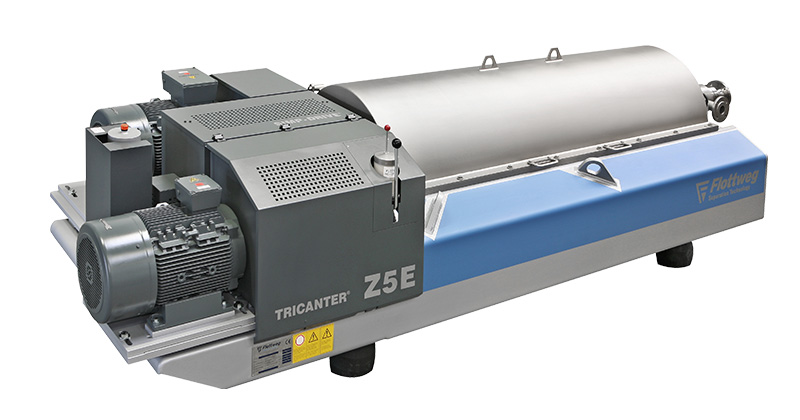
Using a three-phase centrifuge, the organic could be recovered as a clean solution, which could be fed directly back to the SX plant. The savings on organic solution alone amounted to over US$ 12/t of copper produced. A plant producing 50 000 t/a of copper would therefore save approximately $600,000 USD annually. There were additional savings in labor, filter cloths, and maintenance.
Finally, the efficient crud treatment process made it possible to keep crud levels in the SX plants under control. This led to additional savings, as the stability of the SX plant operation improved and its efficiency increased. Disposal of the residual solids also became easier as their organic content was very low.
The Process
Crud needs to be seen as a batch operation. The crud is sucked out of the settlers by operators using diaphragm or peristaltic pumps. The composition can change significantly from day to day. The crud is collected in a feed tank and agitated with a low shear agitator. The solids concentration in the crud normally ranges from 2 to 10 %.
The crud is fed to the three-phase centrifuge and the operators make adjustments to the variable impeller to ensure that the organic solution comes out clean. It must be noted that most crud around the world do not separate into three phases under centrifugation, but rather four phases.
A stable 4th phase builds up at the organic aqueous interface. By adjusting the variable impeller of the three-phase centrifuge correctly, the operator can ensure that this portion of ultra fine solids is discharged as part of the aqueous phase. This is the reason why the aqueous phase is not clear but rather a muddy brown. This aqueous phase has to be sent to tailings. It cannot be returned to the SX plants because it would simply provide seed for more crud to grow upon.
Summary
Twenty years later, most copper SX plants around the world are using three-phase centrifuge for SX crud treatment. More than 80 machines are currently in operation worldwide. When one considers that at present there are around only 59 SX plants in operation with a copper cathode production exceeding 20 kt/, the success of three-phase centrifuge in this application is clear.
The three-phase centrifuge normally becomes a viable option for Copper SX/EW refineries producing 20t/a of copper or more. With the savings it generates in organic recovery, a three-phase centrifuge pays for itself in about four months. The reliability of the machine is also a major advantage as most of these machines are installed in remote regions. three-phase centrifuge which were installed in Zambia 16 years ago are still operating without problem.
While copper SX Crud remains the main application for the three-phase centrifuge in the hydrometallurgical field, it has also been successfully employed in uranium, molybedenum, lithium and zinc SX processes. The three-phase centrifuge has become the standard for crud treatment equipment around the world.
Case Study 2 – Multiple Copper Production Projects in China
Chinese companies supporting CU crud plants in Africa & Myanmar still use chamber filters for the copper crud as their standard. The chamber filter press is very well established. However, through trial runs at several plants, process engineers learned they could save more than 60% solvent after using three-phase centrifuge compared with chamber filters.
The Challenge
Many three-phase centrifuge were being used successfully in South America, USA, Australia, and Africa for Copper SX crud applications. But Chinese companies hadn’t adopted centrifugation yet, still relying on chamber filters for the copper crud process.
The Solution
In 2013, a technical meeting with China Wanbao Mining Myanmar YangTse Copper Mining project team showed interest in centrifuge technology. However, we could not convince the customer as China Nerin Engineering had designed their process using chamber filter technology, and their budget was limited to 30,000.00 Euro.
In 2015, the chamber filter press could not meet expectations. In April 2016, the three-phase centrifuge was commissioned in the copper crud application in Myanmar. Because it was the first application in China, there was a quick learning curve which was addressed and overcome. Challenges were found around few settled fine solids, and higher-than-expected wear caused by excessive bowl speed.
An adjustment was made to the separation disc design, and updates to the scroll provided heavier wear protection using tile protection. The result was a savings of 60% solvent after switching to the three-phase centrifuge vs. the chamber filter. Consequently, neighboring mine Myanmar Wanbao Mining, which is 10 kilometers away from YangTse, also incorporated the centrifuge technology.
Conclusion
In 2018, YangTse bought their second centrifuge for their current works. A third SX plant was built in 2022 using three-phase centrifuges.
Case Study 3 – Various Projects by Fishtec Ltda., Chile
In Chile, mining companies used solvent extraction for many decades in the copper refining process. The Chilean mining industry was not familiar with the three-phase centrifuge technology and used either filter press technology or were forced to discard too much solvent. They were losing product and generating a lot of waste on this new residual phase (CRUD - a mix from organic, aqueous, air and suspended solids).
By constantly removing and treating of the crud through three-phase centrifuges, companies found they reduced the input of new extractant to the SX plant by between 40% to 60%, with significant financial savings.
The Challenge
By using filter press technology, the Chilean mining industry was forced to discard too much solvent. They were losing product and generating a lot of waste all on this new residual phase (CRUD - a mix from organic, aqueous, air and suspended solids).

The Solution
Well-established in Chile in the fishing industry since the 1990s, this has always been Fishtec Ltda.’s core business. In 1995, Fishtec was asked to test a sample of crud from a small mining company, Pudahuel mine. Interestingly, the test showed that this product was remarkably like a sardine production. The similarity was that there are four phases in a mix that must be divided into three. The three-phase centrifuge achieves great results thanks to the adjustable impeller. The fourth phase was separated via the heavy liquid and the organic was recovered totally clean. The new application for the three-phase centrifuge became the best option in this process, improving quality of the product, reducing waste disposal cost and providing a lower operation and maintenance cost.
After this trial, and since solvent extraction was globally gaining acceptance as the most common process in copper mines, the Chilean market opened and three-phase centrifuge were installed on different mines Escondida Coloso (BHP Coloso, 1995) and Quebrada Blanca (Teck, 1995).
Fishtec’ s experience has been that consistently they didn’t have the experience nor the correct machine for the application. Consequently, these two or three phase decanters were installed but never used after failing. Because of this, a negative perception of centrifugation in the copper crud application was starting to form in the Chilean mining industry
Fishtec’s strategy was to “wow” customers with the consistently satisfactory performances. Since then, Fishtec opened the market and achieves almost 95% of the SX plants by using three-phase centrifuge technology.
In 2020, a pilot unit was installed for Codelco Salvador. Codelco is a Chilean national company with six active mine sites, two of which have three-phase centrifuge units in their SX operations. The results were very good, and the client took the initiative to purchase a new three-phase centrifuge unit. The recovery of solvent achieved by the three-phase centrifuge on site is the best solution for a steady state application with predictable performance.
The Process
Fishtec provides a complete solution for the client, adapting the three-phase centrifuge to the site where it is installed. This is true for both greenfield and existing plant sites, adding all the interfaces and aspects that the customer requires on site—from a pump to an operator for the centrifuge.
Conclusion
The experience in this field has provided positive results to show the savings and simplicity of the operation. With a constant treatment of the crud the client will reduce the input of new extractant to the SX plant. The savings is simple to calculate, generally achieving a reduction in the range of 40% to 60% of the input of new solution.
The payback depends on how the machine is operated. A rate of 24/7 will be the best-case scenario to achieve the recovery rate of 6 to 9 months. On the other application treating the residual material “borra” the volume is reduced by almost 60% and recovers 15% to 40% of the material as viable crud. This makes the system a valuable equipment for the complete crud treatment plant.
Author
Robert Klug is a Field Sales Engineer and mining expert with Flottweg Separation Technology.