



- Comprehensive process know-how, customized consulting, and global service - from process engineering to safe plant operation
- Consistently high separation performance even under highly variable feed conditions
- Flexible adaptation to changing process conditions thanks to the adjustable impeller
Innovation for Sustainable Chemical Plastic Recycling
Efficient Use of Resources Through State-of-the-Art Technologies for a Sustainable Circular Economy
Chemical plastic recycling is an important complement to mechanical recycling and enables recycling of a significantly wider range of materials, such as multilayer plastics. Chemical methods make it possible to recycle waste streams of composite materials from industries and households that would otherwise be destined for incineration or disposal. Given the increasing volumes of plastic waste and the growing demands for environmental and resource protection, chemical recycling is becoming increasingly important. It offers innovative technologies that help recover valuable raw materials and reduce the environmental impact of plastic waste.
One of the greatest challenges in plastic recycling is the high heterogeneity of plastic waste. Post-consumer streams, in particular, contain a wide variety of polymers, additives, and levels of contamination, as separation during the disposal process is often inadequate. Therefore, careful pre-treatment—including crushing, washing, and sorting—is also essential for chemical recycling processes. For solid-liquid separation, this means that the composition, density, and viscosity of the feed can vary significantly.
Such variable process conditions require robust, adaptable machines as well as flexible adjustment options for operating parameters. Flottweg supports these processes with high-performance decanter and Tricanter® centrifuges, which enable both pretreatment and subsequent product purification through efficient solid-liquid separation.
Advanced Machines for Efficient Chemical Recycling
Chemical Plastic Recycling Process
After the pre-cleaned plastic waste has been either dissolved or depolymerized in a chemical reactor, the undissolved components must be separated in the subsequent process step, and the solution must be further purified—for example, using activated carbon. Decanter centrifuges are used for this solid-liquid separation.
Once the solution has been sufficiently purified, it can either be used directly for the production of new polymers or the dissolved polymer can be selectively precipitated. The resulting solids must then be mechanically separated from the solvent—another potential application for decanters or Sedicanter® in chemical recycling processes.
Chemical recycling is particularly effective for composite materials and plastics such as PET, which can be easily broken down into their monomers. To achieve high efficiency in the recycling process, mechanical treatment of the plastic waste prior to chemical processing is advantageous. This pretreatment improves material quality, facilitates the separation of material streams, and thus contributes significantly to optimizing the entire recycling process.
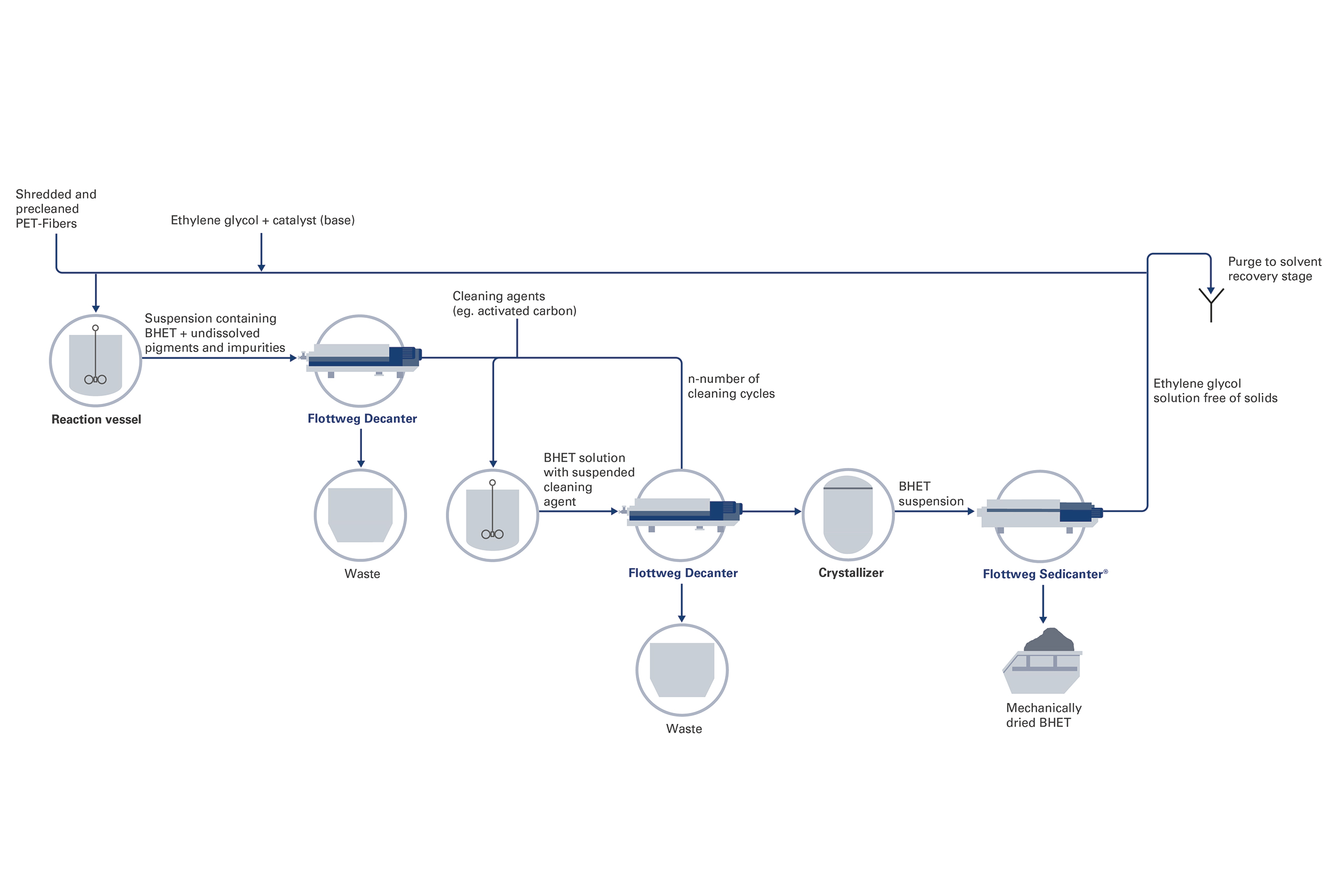 Chemical Plastics Recycling Process
Chemical recycling processes are generally divided into three main categories:
In the solvolysis process, a suitable solvent (often flammable) is used either to dissolve the entire mixture and recover only the desired polymer fraction - or, more commonly, to selectively extract only the desired polymer fraction at elevated temperatures.
This technology is particularly important for post-consumer waste, which often consists of so-called multilayer plastics. Such composite materials contain multiple types of plastic and cannot be mechanically recycled.
In solvolysis, the desired plastic fraction is selectively dissolved and then separated from the remaining materials using solid-liquid separation processess with decanter centrifuges. After that an evaporation of the solvent or precipitation of the polymer fraction with another solvent, which enables further purification and renewed solid-liquid separation.
Solvolysis processes are suitable for many thermoplastic wastes from the packaging, construction, automotive, electrical, and textile industries - including polyethylene (PE), polypropylene (PP), polystyrene (PS), ABS, and polyester (PET). The major advantage is that low-grade waste streams can be processed into products that are nearly as good as new or prepared for depolymerization processes.
Combining these processes with high-performance Flottweg decanter and Tricanter® centrifuges ensures efficient solid-liquid separation and product purification, which optimizes the entire recycling process and improves the quality of the intermediate products.
The feedstock for depolymerization processes consists of plastic waste that is no longer suitable for mechanical recycling but is sufficiently homogeneous. Typical examples include polyester (PET) textile waste, PET film scraps, colored or heavily soiled PET packaging, and mixed fractions of PET- and PA-containing composites that cannot be separated mechanically in a cost-effective manner.
While clear PET beverage bottles can be mechanically recycled well, PET labels, textile waste containing over 90% PET, or PET waste with high proportions of additives and dyes require chemical depolymerization as the preferred method.
In the process, the waste is first shredded, washed, and prepared to a defined particle size. It is then fed into a reactor-solvent system, where temperature, pressure, and suitable catalysts cause the waste to chemically break down into its monomers within the solvent:
- Terephthalic acid (TPA)
- Ethylene glycol (EG)
Depending on the process, such as glycolysis, these monomers are produced with varying degrees of purity. The solvent is treated with purifying agents, such as activated carbon for decolorization, and is separated and purified multiple times using decanter centrifuges. The purified solution is crystallized, whereby the monomers (e.g., BHET) are separated via solid-liquid separation with the Flottweg Decanter or Sedicanter® and brought to polymerization quality.
The recovered monomers can be used to produce new PET pellets without downcycling - a decisive advantage for the circular economy, especially for applications with high quality requirements.
Typical waste streams for depolymerization include:
- PET textile scraps from the apparel industry
- PET film scraps from packaging production
This sector is growing rapidly worldwide, particularly in China, where government programs and major investments by the plastic and textile industries are promoting the expansion of chemical recycling capacities.
Chemical recycling via pyrolysis is a thermal process in which plastic waste is heated to high temperatures in an oxygen-free environment. During this process, the long polymer chains break down into smaller molecules, which can take the form of pyrolysis oil, gas, or coke. The pyrolysis oil obtained serves as a valuable raw material that is processed in refineries or crackers into new plastics or basic chemical compounds.
This process is particularly suitable for mixed or contaminated plastic waste streams that can no longer be used for mechanical recycling - such as films, composites, or heterogeneous plastic mixes. Typical feedstocks are waste streams sorted out from other recycling processes.
Within the overall plastic recycling system, pyrolysis plays an important complementary role: It enables the material recovery of waste that would otherwise mostly be incinerated or landfilled, thereby contributing to increased recycling efficiency, closing the carbon cycle, and reducing dependence on fossil resources.
Why Choose Flottweg as Your Partner for Plastic Recycling

Strong and flexible machines for variable process conditions
Flottweg decanters and Tricanter® centrifuges are specifically designed to ensure consistent and efficient solid-liquid separation even when the composition and density of plastic waste vary significantly.

Adjustable impeller
This advanced technology adapts flexibly to various feed conditions and material properties, thereby optimizing separation performance, increasing process stability, and ensuring consistently high product quality.

Years of experience and tailor-made solutions
Flottweg offers customized process consulting and global service to achieve optimal results in chemical plastic processing.
Combining sustainability and efficiency
With Flottweg machines, customers benefit from high performance and energy efficiency, which help reduce costs and conserve resources.
Get advice from our experts now