



- Recovery of valuable sugar compounds and reduction of product losses
- Treatment of by-products for more cost-effective production processes
- Efficient preclarification of sugar solutions and relief of the load on downstream filtration stages
Flottweg decanters and separators enable the efficient purification of starch-based sugar syrups. They remove fibers, proteins, fats, and other impurities even before filtration, thereby providing significant relief to membranes and filters in the long term and ensuring higher yields, lower operating costs, and consistently high syrup quality.
Reliable Separation Throughout the Entire Sugar Production Process
Flottweg Decanters and Separators for Your Sugar ApplicationsSugar is an indispensable part of our daily lives—whether for sweetening foods and beverages, in the preparation of desserts, or as a key raw material in the food industry. The importance of sugar extends far beyond personal consumption and encompasses numerous industrial applications. Granulated sugar is produced almost exclusively from sugarcane and sugar beets. Both raw materials have a long history and are of great economic importance in various growing regions around the world. The production of various types of sugar syrups (glucose, dextrose, isoglucose, etc.), on the other hand, is usually carried out through the saccharification of starchy plants such as corn and wheat.
Sugar processing is a complex process that requires efficient and sustainable methods to ensure maximum yield and high product quality. Modern technologies and innovative separation processes play a crucial role in conserving resources and increasing economic efficiency.
Flottweg decanters and separators support sugar producers worldwide in the efficient clarification of process water, the dewatering of sludge, and the recovery of valuable components. Whether from sugar beets, sugarcane, or starch-based raw materials—Flottweg offers high-performance and customized solutions for a wide range of applications in the sugar industry. Among other things, the centrifuges are used for purifying sugar beet washing water, processing molasses, filtering sugar syrups derived from starch, and dewatering sugarcane slurry (cachaza).

Higher Sugar Yields
Valuable sugar compounds can be recovered from sugar slurry. At the same time, product losses can be reduced in various process steps.
Less Strain on Filtration and Membranes
During the clarification of starch syrups, fibers, proteins, and other impurities are removed even before filtration. This reduces membrane fouling and increases the service life of the systems.

Enclosed Process Systems
Decanters and separators are closed, fully CIP-compatible separation solutions that offer significant advantages over open filter systems in terms of hygiene, process reliability, and automatability.
Machines for The Sugar Processing
The sugar industry involves numerous solid-liquid separation processes. Washing water must be processed, sludge must be dewatered, and valuable product components must be recovered. At the same time, demands for resource efficiency, process stability, and operating costs are increasing. Flottweg decanters and separators enable reliable separation even under demanding conditions.
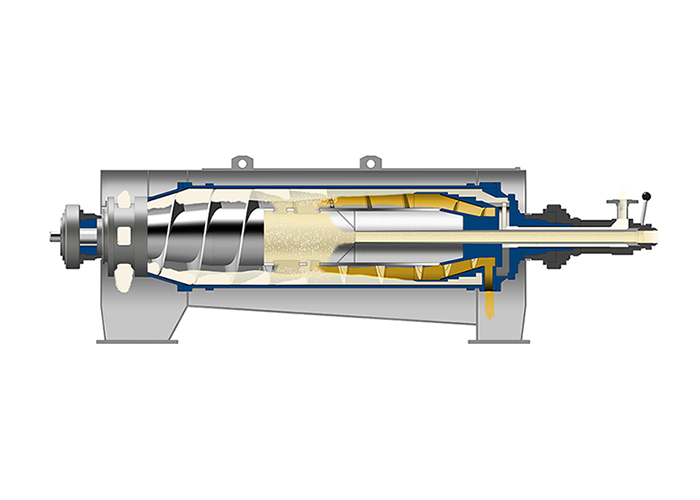
Z6EF – The Innovative Solution for Sugar Clarification
3-Phase Decanter for Floating Solids Removal From Raw Syrup
The Z6EF was specifically developed for the preclarification of raw syrup and the treatment of retentate from ultrafiltration (UF) systems used in sugar purification. Its use can reduce sugar losses by up to 50% compared to processes without a decanter. In addition, the machine ensures more stable operation of the ultrafiltration system and allows for longer running times between cleaning cycles (CIP).
Another advantage of the Z6EF is that it provides relief to downstream filtration systems, such as vacuum drum filters, allowing them to operate for longer periods before cleaning or replacement of the filter auxiliary material is necessary. Since diatomaceous earth is classified as hazardous waste and incurs high disposal costs, the machine also helps lower operating costs. The Z6EF offers economic advantages for new filtration systems: Thanks to improved solids separation, smaller filtration areas can be designed, which significantly reduces investment costs. The machine is particularly suitable for applications with a throughput of up to 20 m³/h in raw syrup processing and represents an efficient solution for maximizing sugar yields.
Applications and Processes in Sugar Processing
From raw material processing to the use of byproducts, sugar processing involves a variety of separation tasks. Flottweg offers the right solution for each of these applications and helps producers improve yield, product quality, and resource efficiency.
Before processing begins, sugar beets and other root crops must be thoroughly cleaned. This process generates large volumes of washing water containing soil, sand, and organic matter. To enable the water to be reused, it first passes through sand separators and then through a cleaner. Depending on the composition of the washing water, polymers may also be added to aid in the separation of solids.
The sludge produced in the clarifier is then fed into the Flottweg decanter, where the solids are efficiently dewatered. While the solids discharge can reach dry matter contents of up to 45 to 60%, the centrate is discharged with a residual solids concentration of only 0.1 to 0.8%. The recovered water can then be returned to the washing process or sent for further processing.
The combination of water recycling and sludge reduction significantly reduces both fresh water consumption and transportation and disposal costs. At the same time, operators benefit from a stable and cost-effective washing process.
During sugarcane processing, a filter sludge—or lime sludge—is produced during juice clarification, which is often designated as cachaza. In addition to fiber, minerals, waxes, sand, and soil particles, this sludge often contains significant amounts of valuable sugar compounds.
Traditionally, vacuum filters are often used for dewatering. Flottweg decanters offer a cost-effective alternative here while also enabling the recovery of sugar from the sludge.
Through efficient solid-liquid separation, the solids are dewatered while dissolved sugar compounds can be recovered during the process. This improves the overall yield of sugar production while simultaneously reducing the amount of waste material to be disposed of.
In addition, operators benefit from a closed-loop process system, a smaller space requirement, and a high degree of automation.
In the production of glucose, fructose, and other sugar syrups from corn or wheat starch, the raw syrup must be purified before further processing. This is often done in ultrafiltration systems or vacuum filters using diatomaceous earth.
A particular challenge is that the fibers, proteins, fats, and partially converted starch components in the syrup increasingly clog membranes and filters. Especially in the final concentration stages, this often leads to capacity losses, increased cleaning requirements, and lower yields.
Flottweg decanters and separators perform the pre-purification of the raw syrup and remove these disruptive components even before filtration. This significantly reduces the load on downstream equipment. Filtration operates more reliably, cleaning intervals are extended, and product losses are minimized.
The result is a more efficient overall process with higher product quality and more economical use of the filtration systems.
Molasses is a byproduct of sugar production from sugarcane and sugar beets. Despite its status as a byproduct, it is a valuable raw material with a wide range of applications. For example, it is used in yeast and alcohol production, as well as in the manufacture of citric acid and antibiotics. In addition, molasses is used as an animal feed additive and in numerous applications in the food industry.
Since molasses often comes from different suppliers, its properties and quality can vary significantly. For many industrial and biological processes, targeted processing is therefore necessary to ensure consistent product quality and to remove unwanted impurities. These impurities include, in particular, sand, sulfate salts such as calcium or potassium sulfate, and proteins.
Flottweg decanters and separators reliably and efficiently remove these undesirable components. The result is a significantly improved raw material quality, which creates optimal conditions for downstream production processes and sustainably enhances the quality of the end product.
Depending on the requirements, molasses is processed in a multi-stage procedure. In this process, decanters separate coarse solids, while separators perform fine purification. The purified molasses is then either stored or fed directly into further processing.
Frequently Asked Questions – FAQ
Decanters and separators are suitable for a variety of separation tasks throughout the entire sugar production process. These include the processing of sugar beet washing water, the dewatering of sludge, the clarification of raw syrup, the pre-treatment of starch-based sugar syrups, the treatment of ultrafiltration retentates, and the clarification of molasses. This helps reduce wastewater, remove solids, and recover valuable sugar compounds from byproducts.
Yes. The solutions described are used in the processing of both sugarcane and sugar beets. In addition, they are suitable for the production of glucose, dextrose, fructose, and other sugar syrups from corn or wheat starch.
Decanters and separators operate as closed systems that are fully CIP-capable. This offers advantages in terms of:
- Hygiene
- Continuous operation
- Reduced space requirements
- No vacuum required
- No filter auxiliary material required
- Reduced product contact with the environment due to closed systems
In addition, there is relief for downstream filtration and membrane systems, which can increase their service life.
Decanters enable the recovery of valuable sugar compounds from side streams and process residues. Raw syrups, ultrafiltration retentates, and sugarcane slurries, in particular, may still contain significant amounts of sugar. Through separation, these sugar components are retained in the process. This reduces product losses and improves the overall yield.
Operating costs can be reduced by several factors:
- lower fresh water consumption
- reduced sludge volume
- lower disposal costs
- less stress on filters and membranes
- longer operating times between cleanings
- lower consumption of filter aids
Actual savings depend on the specific process conditions.
The Z6EF is a specially designed 3-phase decanter for the preclarification of raw syrup and the treatment of retentates from ultrafiltration systems. It is used to separate solids and floating components prior to subsequent filtration or purification processes.
The Z6EF decanter centrifuge supports sugar producers by:
- Reduction of sugar losses
- Relief from load on ultrafiltration systems
- Stabilization of filtration
- Extension of CIP intervals
- Reduced load on vacuum drum filters
- Improved process stability
This reduces operating costs and increases yields.
The machine is particularly suitable for applications with throughputs of up to approximately 20 m³/h in raw syrup processing. For higher capacities, a custom design is required.
The solids discharge can reach dry matter contents of approximately 45 to 60 percent. The centrate, meanwhile, has residual solid contents of only about 0.1 to 0.8 percent. This ensures that water and solids are efficiently separated from one another.
In many applications, decanters offer a cost-effective alternative to vacuum filters. They operate continuously as a closed system, require less space, and do not require a vacuum. At the same time, they enable the recovery of valuable product components.
Separation Expertise for the Sugar Industry
Our many years of experience in the food, starch, and sugar industries form the foundation for our high-performance process solutions. Through close collaboration with manufacturers and operators, we have a deep understanding of the specific requirements and challenges involved in sugar processing. Our technologies are designed to ensure the highest levels of efficiency, reliability, and cost-effectiveness.

Automatic Adaptation to Process Changes
With technologies such as Simp Drive® and application-optimized decanter solutions, the machine can adapt to changing feed conditions and ensure consistently high separation performance.

Robust Technology for Demanding Applications
Special wear protection designs and high-quality materials protect the machine even when handling abrasive media such as sandy sugarcane slurry.

Customized to Suit the Application
Depending on the process step, decanters, separators, or specialized separation solutions are used and designed for the specific application.
Contact us now