


2026-08-28
Producing Plant-Based Dairy Alternatives Efficiently: Why Solids Separation Determines Product Quality and Profitability

The challenge is finding exactly the right balance. Our decanter reliably removes coarse fibers while retaining the fine particles that are essential to the product’s desired mouthfeel.Justin Wagner Sales Manager for Plant-Based Dairy Alternatives at Flottweg
Demand for plant-based dairy alternatives continues to grow. At the same time, manufacturers face increasing expectations: Consumers demand consistently high product quality, a pleasant mouthfeel, and a stable product structure. One process step plays a particularly critical role in meeting these requirements: solids separation.
We spoke with Justin Wagner, Sales Manager for Plant-Based Dairy Alternatives at Flottweg, about how modern decanter centrifuges help ensure oat drink quality while enabling flexible and cost-efficient production processes.
Mr. Wagner, what challenges are involved in producing oat drinks?
Following the milling and hydrolysis process, a so-called oat slurry is created. It contains both coarse plant fibers and fine particles that are critical to the sensory properties of the final product. The challenge lies in achieving exactly the right balance. Our decanter processes the oat slurry in a way that reliably separates the coarse fibers while retaining a defined proportion of fine particles in the product. These fine particles contribute to the desired mouthfeel. Too many solids can negatively impact product stability, while too few may adversely affect taste and texture.
How does this separation process work in practice?
At Fidel Dreher in Stockach, a Flottweg decanter performs the 2-phase separation of the oat slurry. High centrifugal forces push the solids against the bowl wall. A rotating scroll continuously transports the solids toward the solids discharge, while the clarified liquid is discharged under pressure via an impeller. This continuous separation principle enables reliable processing, even at high production volumes. At the same time, it provides the foundation for consistently high product quality because the process can be controlled with great precision.
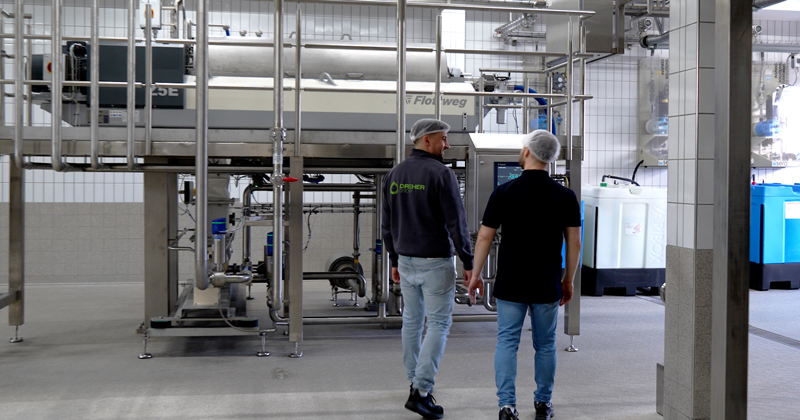 Flottweg supported Fidel Dreher in setting up their plant-based drink production line.
How important is process control for product quality?
It is extremely important. In the production of plant-based dairy alternatives, reproducibility is critical. Raw materials and formulations may vary, but consumers still expect consistent product quality. Through the automatic torque control of our decanter, we ensure that the discharged solids always achieve minimum residual moisture. At the same time, we can precisely define how much residual solids content should remain in the finished plant-based drink. This enables manufacturers to reliably reproduce the desired product characteristics while adapting separation performance to different requirements.
Foam formation is often discussed in connection with plant-based drinks. What role does it play in the process?
Foam formation is indeed a particular challenge. The proteins contained in plant-based dairy alternatives can generate unwanted foam during processing. This foam can complicate downstream process steps and negatively affect process stability. To address this challenge, we developed a special low-foam discharge system. It allows us to reduce foam generation in the product to a minimum. This not only improves overall process stability but also facilitates downstream processing and filling operations.
Producers today work with a wide variety of raw materials and formulations. How flexible is decanter technology?
Flexibility is a key factor today. Manufacturers are no longer producing only traditional oat drinks. They process a wide range of raw materials and continually develop new product variants. Our decanter technology can handle different products and raw materials. This is made possible by an integrated recipe management system. Once process parameters have been defined, they can be stored and recalled whenever needed. This simplifies product changeovers, reduces setup times, and significantly increases production flexibility.
In addition to product quality and flexibility, hygiene standards play an important role. How is this ensured?
Cleanability is of utmost importance, particularly in the food industry. For this reason, the decanter installation at Fidel Dreher has been fully integrated into the existing CIP system. As a result, cleaning can be performed fully automatically at any time. This reduces manual effort while ensuring safe and reproducible cleaning of the entire system. For manufacturers, this means a high level of process reliability combined with efficient cleaning procedures.
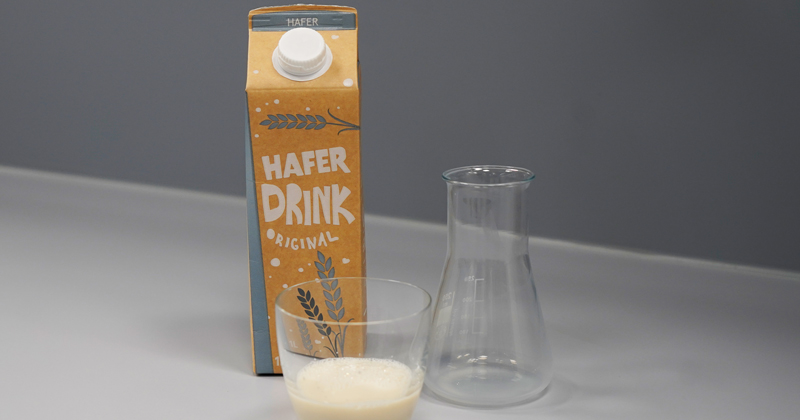
Ultimately, what contribution does modern decanter technology make to the production of plant-based dairy alternatives?
Solids separation has a direct impact on product quality, mouthfeel, and process stability. Modern decanter centrifuges help manufacturers meet these requirements reliably while maintaining cost-efficient production. Automatic control systems, flexible recipe management, low-foam discharge systems, and full integration into existing CIP processes provide the foundation for stable and efficient operation. The example of Fidel Dreher demonstrates how the right separation technology can help manufacturers produce plant-based dairy alternatives with consistently high quality in a flexible and economical manner.
About Justin Wagner
Justin Wagner is Sales Manager for Plant-Based Dairy Alternatives at Flottweg. He supports manufacturers in designing and optimizing processes for the production of plant-based beverages and assists customers in selecting the most suitable separation technologies for their applications.